
Part 3 of the CEO Decision Trilogy: Chapters 19, 22, and 21 from What Every CEO Must Know
If you’ve been following this series, you’ve already built your personal decision-making operating system in Chapter 19, the Auto-Process for fast decisions and the Fast-6 for high-stakes critical decisions. You learned in Chapter 22 how silence and delay can cost your company more than a bad decision ever would.
Now we close the trilogy with the question every CEO faces at some point, and usually at the worst possible moment.
Your gut says one thing. The data says another. The team is watching. The clock is ticking.
Which do you trust? CEOs I have worked with have uniquely different perspectives here, and could debate for hours on their opinions and their own decision process techniques.
I’ve been asked this question more times than I can count across nearly 40 years in the executive arena. My answer never changes: you’re asking the wrong question.
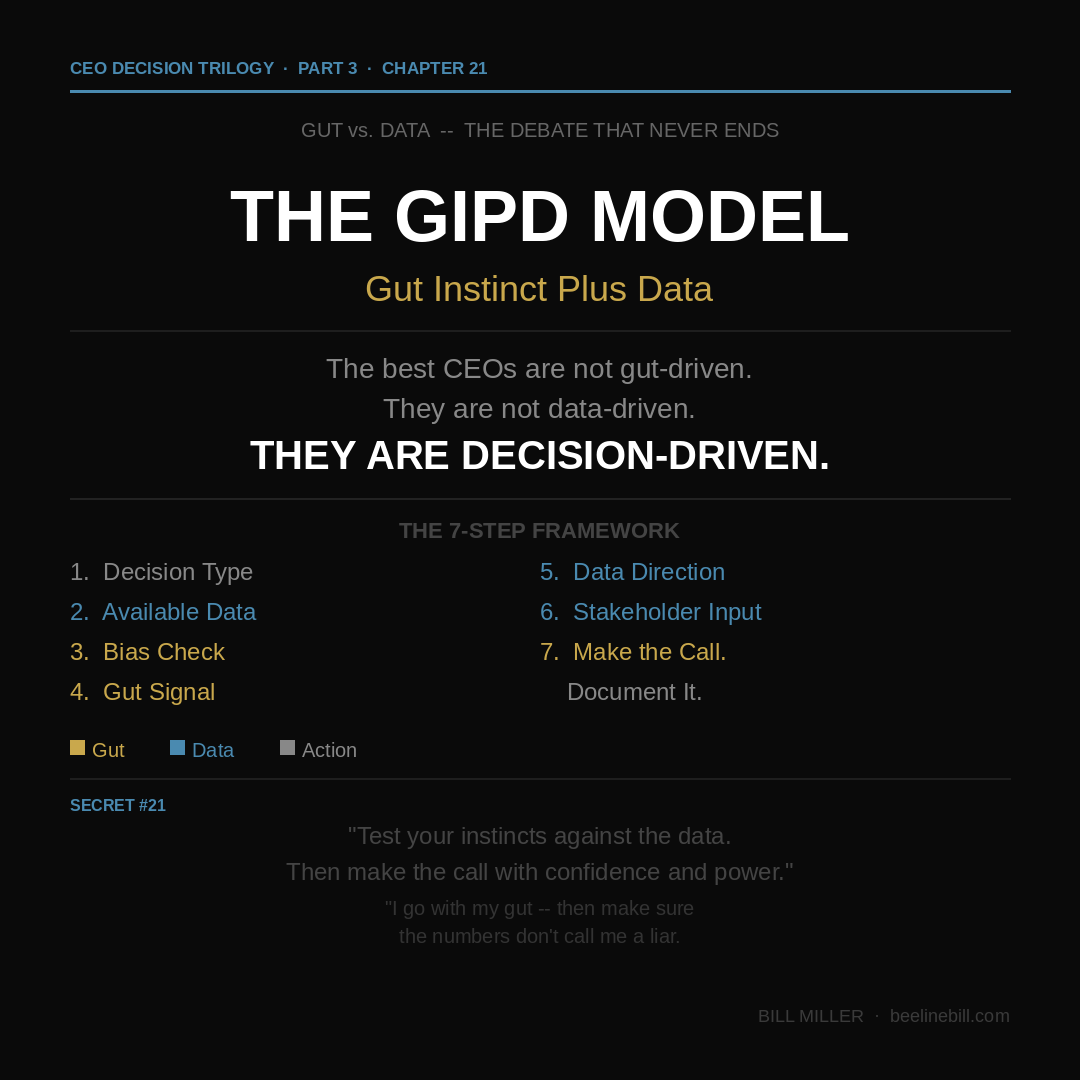
The best CEOs aren’t gut-driven. They aren’t data-driven. They are decision-driven. And in Chapter 21 of What Every CEO Must Know, 37 Secrets to Lead with Confidence and Power, I give you the framework that makes that possible: the GIPD Model.
When Gut-Only Goes Wrong
“The Opportunist,” a CEO from my first book, The Rookie CEO, You Can’t Make This Stuff Up! makes a return here because his story is one of the most instructive I’ve ever worked through.
He was smart, energetic, and had built a solid team with real wins behind him. But his decision process, especially around people, was driven almost entirely by instinct. And that instinct had no checks or guardrails on it.
If he liked you in an interview, you got an offer on the spot. No process. No scorecard. No team input.
If something felt off about an employee, even a high performer, you were gone and walked out the door without an explantion.
He once passed on a high-performing customer success leader because he didn’t “vibe” with the candidate. His interview team unanimously wanted to hire that person. The performance data supported the hire. His gut said no. His gut won.
He hired someone else because he liked the way that candidate “sounded.” That hire had zero client-facing capability, demoralized the team within 90 days, and was out the door before the quarter ended.
The result? Burned bridges. A rattled team. A broken hiring process. And a company that hit a growth plateau driven entirely by three preventable decisions made on feeling alone.
When the chaos became obvious and predictable, he asked for help. That single decision, and his desire to get a framework, changed his company forever.
Why Gut-Only Gets Dangerous as You Scale
In the early days of any company, gut instinct is a survival tool. There’s no clean data, no dashboards, no HR infrastructure. You move fast. You trust your read. That’s not a flaw. It’s how many startups survive.
But as the company grows and the stakes rise, that same instinct-only model becomes a liability. Here’s the uncomfortable truth: gut instinct is shaped by emotion, ego, bias, and past experience. That’s not always wrong. But it’s always incomplete.
Especially when you’re making executive hires. Cutting budgets. Deciding to shut down or pivot a product line. Reorganizing a team that’s already stretched thin. These are the moments when unchecked instinct becomes a blind spot. And blind spots, as I’ve written throughout this book, are where companies get hurt and can be dmaged for a long period of time.
The GIPD Model: Gut Instinct Plus Data
What I built with is a seven-step framework I now use with every CEO I coach when they’re facing a complex or high-stakes decision. I call it the GIPD Model, or Gut Instinct Plus Data.
It doesn’t remove your gut from the process. It gives your gut a reality check. Here’s how it works:
Step 1: Decision Type. Define the decision clearly before you start deciding. Set SMART goals and establish a scoring system. Know what you’re actually choosing between.
Step 2: Available Data or Creating Data. For operational decisions, the data already exists. Track it and monitor it on a scorecard of some type. For other decisions, bring your leadership team in to build a scoring system together and assign a scorekeeper. If the data doesn’t exist yet, create it.
Step 3: Bias Check. This is the step most CEOs skip, and the one that matters most. Ask yourself honestly: what is driving my emotion right now? Is it fear? Ego? A past experience that’s coloring how I see this situation? Name it before you act on it. You can’t neutralize a bias you won’t acknowledge.
Step 4: Gut Signal. Your instinct still has a seat at the table. What is it saying, and more importantly, why? Gut signals grounded in pattern recognition and experience have real value. Gut signals driven by emotion and ego don’t. Knowing the difference is the skill.
Step 5: Data Direction. What are the actual metrics and inputs pointing to? Pull this directly from Step 2. Compare it against your gut signal from Step 4. Where do they agree? Where do they conflict? That gap is where your real decision lives.
Step 6: Stakeholder Input. Bring in your team for trade-off discussions. What do they see from their vantage point? What risks do they flag? Let them challenge the decision constructively. This isn’t weakness, it’s leadership. And it builds the trust that makes your team execute once the decision is made. It elimintes blind spots the team sees that you don’t see.
Step 7: Make the Call. Document It. Write it down. Record the logic, the inputs, the risks, and the expected outcome. You’ll use that record to sharpen your process over time, and to explain your reasoning to your team, your board, and yourself.
Some CEOs resist this framework at first, as most gut-driven CEOs do. “It slowed me down,” the CEO told me. Three months later he said, “It saved us.”
His hiring quality improved. Reactive organizational changes stopped. His leadership team trusted decisions more because they felt fair, thoughtful, and explainable. The company culture strengthened enough to attract an acquirer.
The GIPD in Practice
Here’s what a GIPD decision document looks like for a real hiring decision, possibly the most common place I see gut-only decisions go wrong:
Decision: Hire new VP of Marketing, full time or fractional. Desired Outcome: Drive 30% pipeline growth in two quarters. Options Considered: Internal promotion vs. external hire. Scoring Criteria: Team fit, ICP knowledge, execution track record. Supporting Data: Interview scorecards, references, prior pipeline metrics. Risks: Culture misfit, slow ramp-up time. Mitigations: 30-60-90 day scorecard with weekly CEO review. Decision Owner: CEO.
Simply created on one page. Every major variable on the table. Gut still in the room, but the numbers and the team each get a vote.
You can adapt this exact format to any complex decision: pricing changes, product pivots, layoffs, partnerships. The structure is the same. The discipline is the same.
The Mindset Shift That Changes Everything
The Opportunist used to say, “I go with my gut.” After working through the GIPD style framework consistently, he said something I’ve quoted in boardrooms and coaching sessions ever since, and I love it:
“I go with my gut, then I make sure the numbers don’t call me a liar.”
That’s the whole shift right there. That’s what it means to be decision-driven.
CEOs don’t have the luxury of always being right. But they do have the responsibility to be rigorous. Gut instinct is fast, human, and genuinely valuable. Left unchecked, it becomes a blind spot. Tested against real data and honest team input, it becomes your edge.
Blend intuition with information. Lead with courage. Decide with clarity.
Closing the Trilogy
This is Part 3 of the CEO Decision Trilogy from What Every CEO Must Know. Here’s how the three chapters work together as a complete system:
Chapter 19 gives you the operating system: the Auto-Process for fast decisions and the Fast-6 for hard ones. Chapter 22 shows you what happens when you over-analyze and never commit, and gives you the Decision Readiness Scorecard to break the paralysis. Chapter 21 gives you the GIPD Model to balance instinct with evidence so every major call is made with both courage and clarity.
Three frameworks. One decision-making OS. Fully customizable for your company, your leadership style, and your situation.
Secret #21: The best CEOs are not gut-driven or data-driven, they are decision-driven. Make it a habit to test your instincts against primary information and data. Then make the call with confidence and power.
I hope you enjoyed this trilogy and the three secrets from them. Want more like this? They can be found in What Every CEO Must Know, 37 Secrets to Lead with Confidence and Power, see link below.
= = =
Thank you for stopping by the CEO Insights blog. I appreciate your readership.
= = =
Effective April 6, 2026 through the end of the month, both of my eBooks are available on Amazon for a promotional price of $.99 USD.
To purchase my first 2-time ward winning book, “The Rookie CEO, You Can’t Make This Stuff Up!” in any format, please visit https://www.amazon.com/dp/B08LSLLXZN. Amazon has four formats. You can purchase the hardcover and audiobook at any retail bookstore or ask your local library. The eBook and paperback are currently available on Amazon.
To purchase my new award-winning book, What Every CEO Must Know, 37 Secrets to Lead with Confidence and Power in eBook, paperback, or hardcover, please visit https://www.amazon.com/dp/B0FVVJN8FL. Print editions may be purchased at most retailers online, or you can order from your favorite bookstore or library.