
Every CEO I’ve ever coached has faced this moment. A promising opportunity sits on the table. The data looks good. The team is ready. The market is signaling. And yet the decision doesn’t get made.
The CEO asks for more analysis, more modeling. Everyone involved is asked to show more patience. The calendar moves and the moment passes.
This is analysis paralysis. And in Chapter 22 of my new book, What Every CEO Must Know, 37 Secrets to Lead with Confidence and Power, I walk through one of the most instructive yet quietly devastating examples of what it costs when a CEO mistakes delay for diligence.
The General was not ready, but the market and channel were
Let me reintroduce a CEO I call “The General,” whom I introduced in my first book, The Rookie CEO, You Can’t Make This Stuff Up! He makes a return appearance here for good reason. He was a thoughtful, experienced leader. He had decades in the business and a strong operational command. An eye for detail.
And when his company’s most significant product expansion opportunity arrived, he froze. He would argue this point.
His best salespeople were vocal advocates. The reseller channel was actively requesting the new offering. Customer demand was real and documented. He had the data. He had internal support. What he lacked was the willingness to publicly own the trade-off and make the call.
His stated reason? Maybe it was that the capacity of an already overloaded development team was already stretched thin, and overcommitted with existing feature requests. Prioritization was hard, and every project seemed to matter. So rather than make the hard call, he asked for more analysis. Then more modeling. Then more patience.
It wasn’t a no. It wasn’t a yes. There was silence to the frustration of some of his most trusted leaders.
And silence, as I’ve learned across more than four decades in executive roles, can kill momentum faster than a bad decision.
What Silence Costs
Over time, the frustration inside the company became palpable. Salespeople stopped asking. The one internal champion who kept pushing and responding to each new round of requested analysis with fresh competitive updates and market data eventually ran out of steam.
The project sat on ice. Three years passed.
When the decision was finally made, the product did launch. It actually performed well. Customers adopted it. The channel re-engaged. But here’s the Good, the Bad, and the Ugly of what that delay produced:
The Good: the product worked, and it stabilized growth. The Bad: competitors had already moved in during the three-year window. What could have been a first-mover advantage became a late-stage catch-up play. The team was burned out from the stop-start whiplash of competing priorities, and a significant revenue opportunity was lost.
The Ugly: the most serious damage was internal. Trust in leadership took a hit that didn’t heal quickly. Some people left. Some channel partners never came back. And much of the leadership team felt excluded from a decision that directly affected them.
Most telling? The General never acknowledged the delay as a mistake. To him, the timing was finally right. To the company, the cost was real and lasting. Again, he might argue this point.
The Root Cause: No Framework, No Transparency
The General’s flaw wasn’t that he cared too much about getting it right. That’s not a flaw, that’s a virtue. The mistake was in what surrounded his deliberation: no transparency, no shared criteria, and no deadline.
Nobody outside a two-person inner circle knew where the decision stood. He kept requesting analysis without sharing his intent, direction, or the conditions that would satisfy him. It was, as I write in the book, like asking for directions without saying where you’re heading.
What makes this mistake so common and so dangerous is the trap CEOs fall into, believing that more data will eventually clarify the answer. But in the General’s case, the data had already told the story. He had customer demand, sales enthusiasm, a real market window, and a clear internal roadblock. What he lacked was a framework for making the call.
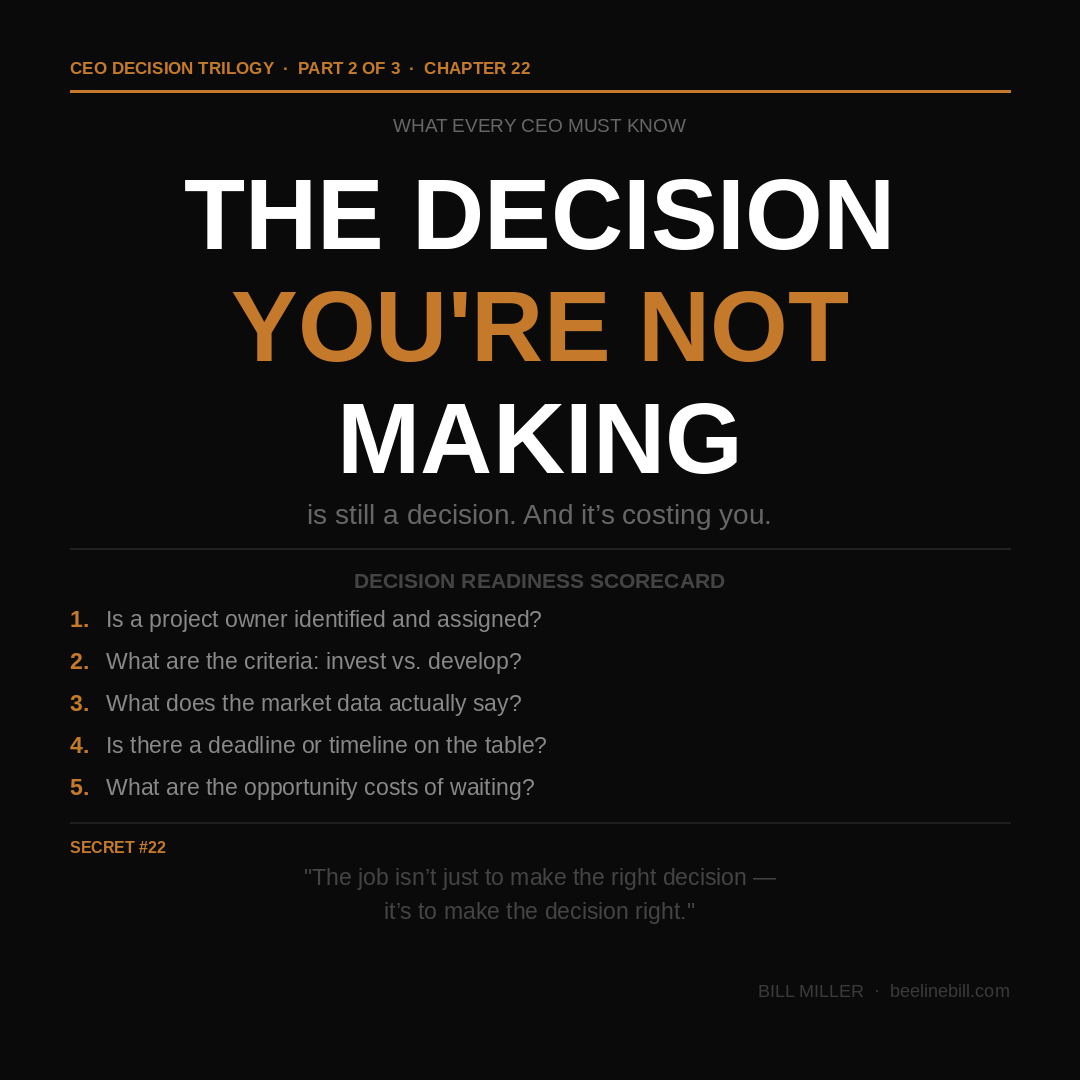
The Decision Readiness Scorecard
This is the tool that could have changed everything for the General and the one I now use with every CEO I coach who’s stuck in the in-between. Before any major strategic decision stalls out, answer these five questions:
1. Is an initiative or product owner identified and assigned? If no one owns it, it won’t move. Assign ownership before the analysis starts, not after the decision is made.
2. What are the criteria: invest vs. feature development? Get explicit about what a “yes” looks like. What conditions need to be true? What are the deal-breakers? Without this, every round of analysis feels incomplete.
3. What does the market data actually say? Size the opportunity. Get a current competitive update. If the market is moving, the clock is ticking, and the scorecard should reflect that urgency.
4. Is there a deadline or timeline? Without a date, it’s discussion, not decision-making. Set a decision deadline and work backward from it. This alone transforms the dynamic.
5. What are the opportunity costs of waiting? This is the question most CEOs skip. Every week of delay has a cost: lost revenue, lost talent, lost market position. Name it. Put a number on it if you can.
If you can’t answer those five questions clearly, you’re not waiting for data. You’re avoiding the decision. And there’s a meaningful difference between the two.
How to Avoid the Trap
Beyond the scorecard, here are the habits that separate decisive CEOs from paralyzed ones:
Communicate status, even when the answer is “not yet.” Silence signals inaction to your team. A simple update such as “we’re still working through X before we can commit” preserves trust and momentum. Prioritize with courage. No development team can do everything. Your job as CEO is to choose, and choosing means someone else’s priority gets bumped. Own that trade-off publicly instead of hiding it behind more analysis. Accept imperfect information. Waiting for perfect data is waiting forever. The best leaders make quality decisions with the best available information and adjust as new data arrives.
Recovery Is Possible But Delay Has a Price
To his credit, the General did eventually make the call. He committed resources. He supported the launch. He began using a prioritization framework going forward and involved his extended leadership team earlier in the process.
But what could have been a celebrated internal win became a “finally” moment. The team applauded, but quietly. The energy of a first launch had been replaced by the relief of a long-delayed one.
That’s the hidden cost of analysis paralysis. Not just the lost market opportunity, but the erosion of team confidence in leadership’s ability to move. And the General was a highly respected leader.
Are you this CEO?
Secret #22
Delaying a decision isn’t always the worst choice. But doing so without transparency, prioritization, and a clear end point is. CEOs must learn to act with confidence, even when all the data isn’t in. The job isn’t just to make the right decision, it’s to make the decision right. That is leading with confidence and power.
This is Part 2 of the CEO Decision Trilogy in What Every CEO Must Know. Part 1 covers building your personal decision operating system (Chapter 19). Part 3 covers balancing gut instinct with data using the GIPD Model (Chapter 21). All three are waiting for you in the book.
= = =
Thank you for stopping by the CEO Insights blog. I appreciate your readership.
Effective April 6, 2026 through the end of the month, both of my eBooks are available on Amazon for a promotional price of $.99 USD.
To purchase my first 2-time ward winning book, “The Rookie CEO, You Can’t Make This Stuff Up!” in any format, please visit https://www.amazon.com/dp/B08LSLLXZN. Amazon has four formats. You can purchase the hardcover and audiobook at any retail bookstore or ask your local library. The eBook and paperback are currently available on Amazon.
To purchase my new award-winning book, What Every CEO Must Know, 37 Secrets to Lead with Confidence and Power in eBook, paperback, or hardcover, please visit https://www.amazon.com/dp/B0FVVJN8FL. Print editions may be purchased at most retailers online, or you can order from your favorite bookstore or library.