
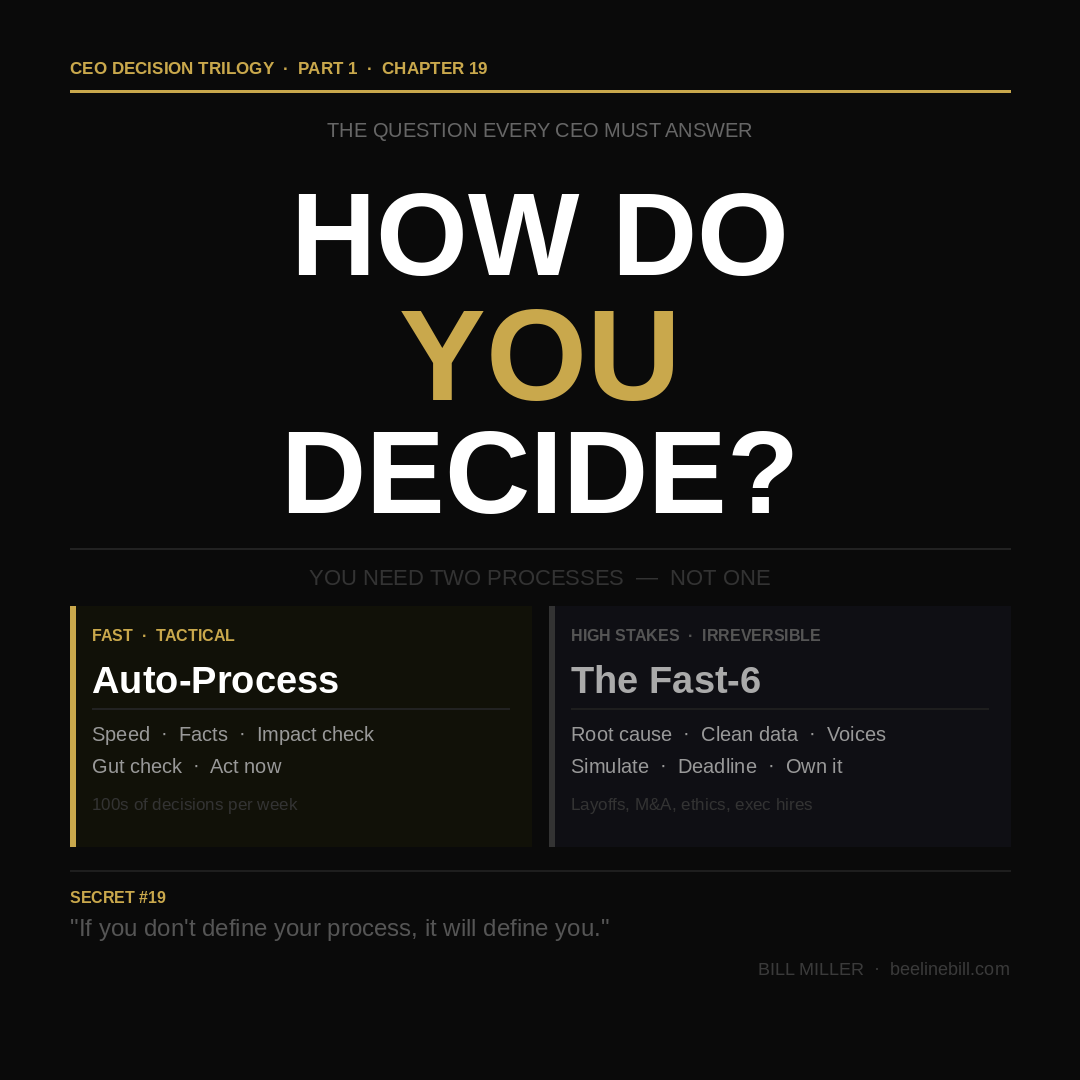
CEOs aren’t measured by what they intend. They’re measured by their decisions. Not just what they decide, but how they decide. This drives outcomes.
I’ve spent almost four decades in executive roles and, over the past several years, have been coaching and advising CEOs across industries. And I can tell you: the single most overlooked leadership asset isn’t vision, culture, or talent. It’s decision process. Although they all contribute, decision-making is the key to eliminating your blind spots.
Every mistake I’ve seen, from the wrong hire, the delayed pivot, the ethics failure, the blown M&A, they all started with a faulty process. Or no process at all.
That’s why Chapter 19 of my new book, What Every CEO Must Know, 37 Secrets to Lead with Confidence and Power, is dedicated entirely to building your personal decision-making operating system. Let’s unpack it here.
The Mistake Most CEOs Make
Most CEOs lead without a clear, documented understanding of how they actually make decisions. They have a process – we all do – but it lives in their head, shaped by instinct, background, and experience. That’s fine when the stakes are low. It’s dangerous when they’re not.
The problem shows up in three ways I see repeatedly:
- A rushed auto-decision was made without the right inputs.
- A prolonged, over-analyzed choice that paralyzes the team.
- Or a politically motivated decision that satisfies no one and solves nothing.
Your company deserves better than any of those.
Two Processes Every CEO Needs
Here’s the foundational insight: you don’t need one decision process, you need two. And knowing which one to use and when is the skill.
The Auto-Process: For Fast, Tactical Decisions
As CEO, you’re making hundreds of these every week. Meetings, messaging, spending decisions, product tweaks, and quick non-critical hires. The auto-process is built for speed, and speed matters because time kills opportunities.
My auto-process framework has five elements: Speed (act fast), Facts (grab just enough accurate data), Impact Questions (who does this affect, and is it reversible?), a Gut Check (yes or no, but only after the facts and impact are considered), and Action (do it now). Simple. Repeatable. Fast.
The critical warning here: know when you’re in auto-mode and when you absolutely shouldn’t be. Auto-processing on a high-stakes, irreversible decision is one of the most common and costly CEO mistakes I see.
The Fast-6: For High-Stakes, Deliberate Decisions
I have created this mini-framework to help guide CEOs and leaders to make decisions with clarity. When the decision involves risk, ethics, layoffs, executive hires, M&A, or anything that can’t easily be undone, you need a completely different framework. I call it the Fast-6 Decision Framework:
- Name the problem. Not the symptoms but the root cause.
- Collect clean data. Both quantitative and qualitative (without over-analyzing)
- Select voices. Three to five inputs max, from people who actually matter to the decision.
- Run simulations. “What if” each possible outcome before you commit.
- Set a decision deadline. Without a date, it’s just a discussion. And discussion without a deadline causes paralysis.
- Own it. Communicate it. Share the why, not just the what. Your team needs the reasoning, not just the verdict. This step alone is very helpful to your leadership team.
I’ve watched CEOs transform their team’s trust and their company’s trajectory simply by adopting this six-step process for their hardest calls.
Moat CEOs already have their personal brands and decision-making processes, but my mini framework helps fill the gaps exposed in those processes.
Three Proven Decision Frameworks Worth Knowing (there are many more)
Beyond my Fast-6, there are three widely adopted frameworks that top-performing CEOs have used to sharpen their decision-making muscle. Visionary CEOs don’t blindly adopt these; they adapt them.
OODA Loop (Observe, Orient, Decide, Act): Developed by U.S. Air Force strategist John Boyd, this framework is built for dynamic, competitive environments. It focuses on agility: gather data, understand context, make the call, take action, then loop back. Jamie Dimon of JPMorgan Chase uses it regularly.
First Principles Thinking: Break complex problems down to their fundamental truths and build up from there. Avoid the analogy traps that lead most leaders to recycle old solutions for new problems. Elon Musk, Jeff Bezos, and Reed Hastings have all championed this approach.
RAPID Framework (Recommend, Agree, Perform, Input, Decide): Developed by Bain & Company, this framework clarifies roles in the decision-making process. It prevents bottlenecks by defining who does what at every stage. Particularly powerful for team-impacting or cross-functional decisions.
Here’s a simple reference to help you choose:
| Decision Type | Process | Team Involved? |
|---|---|---|
| Fast action, tactical | Auto-Process | No |
| High risk, strategic | Fast-6 | Yes |
| Team impacting | RAPID or OODA | Select members |
Build Your Personal Decision Stack
Every CEO needs a documented decision stack, not just a mental one. Here’s how to start building yours today:
What are your top three recurring decision types? Which of those are auto-decisions, and which require your deliberate process? Who are your go-to voices for each type? What’s your target time-to-decision for each? And what feedback loop do you have in place to improve your process over time?
Once you map that out, you’ve got your operating system. Then make it a habit. Share it with your leadership team. Use a Decision Journal to document the logic, inputs, timeframe, and outcomes of your hardest calls. Over time, your process sharpens, your team becomes more aligned, and your decisions become faster and cleaner.
One more idea worth considering: build a custom AI agent or GPT to help you collect decision data points and refine your process. The tools exist. Use them. I am developing one for my clients, a “beelinebill advisor” that addresses all 37 secrets of my book and more.
The Bottom Line
Secret #19 from What Every CEO Must Know puts it plainly: your decision process is your CEO operating system. If you don’t define it, it will define you.
The best CEOs lead with clarity, not ambiguity. They lead from the front. They lead with decisions, not delays. And their decisions are made with process, not guesswork, to define their destiny.
Do you have your decision stack documented? Or is it still living in your head?
If you want the full framework, the complete Decision Stack reference, and 36 more secrets from seasoned founders and battle-tested CEOs, pick up your copy of What Every CEO Must Know: 37 Secrets to Lead with Confidence and Power, available here on Amazon.
I will be following this post with the next two parts of the Decision-Making Process Trilogy – Chapters 22 and 21 will bring more into your view.
= = =
Thank you for stopping by the CEO Insights blog. I appreciate your readership.
Effective April 6, 2026 through the end of the month, both of my eBooks are available on Amazon for a promotional price of $.99 USD.
To purchase my first 2-time ward winning book, “The Rookie CEO, You Can’t Make This Stuff Up!” in any format, please visit https://www.amazon.com/dp/B08LSLLXZN. Amazon has four formats. You can purchase the hardcover and audiobook at any retail bookstore or ask your local library. The eBook and paperback are currently available on Amazon.
To purchase my new award-winning book, What Every CEO Must Know, 37 Secrets to Lead with Confidence and Power in eBook, paperback, or hardcover, please visit https://www.amazon.com/dp/B0FVVJN8FL. Print editions may be purchased at most retailers online, or you can order from your favorite bookstore or library.