
A CEO I was advising said something I’ve heard a dozen times in a dozen ways:
“We are moving too fast to stop the momentum and train my team!”
I understood his thinking.
Customers need attention.
Products need to ship.
Revenue targets need to be hit.
Problems need to be solved.
Who has time to stop and train people when everyone is already running at full speed?
Six months later, that same CEO told me:
“I think we need to grow our people after all. Can you help me?”
There is a lesson here for every CEO.
Your company cannot consistently grow faster than the people running it.
Eventually, something breaks.
The Mistake: Assuming Great People Will Figure It Out
In Chapter 14 of What Every CEO Must Know, I call this mistake failing to create a learning culture early on.
CEOs hire smart people and assume they will figure things out.
They fail to provide coaching, upskilling, or training.
Senior leaders receive little feedback or guidance.
Employee development gets pushed aside until performance problems appear.
And there is always a good excuse:
We are too busy right now.
I have seen this across companies for years.
As a company grows, the jobs grow with it.
The person who was perfect for a $2 million company may need new skills to help lead a $10 million company.
The first-time manager suddenly has five people reporting to them.
The technical expert becomes responsible for developing other technical experts.
The salesperson becomes the sales manager.
The founder becomes the CEO.
Every one of those transitions requires learning.
If the people don’t grow, execution eventually suffers.
Deadlines get missed.
Customers become disappointed.
Problems start flowing uphill.
And the CEO gets sucked deeper into the business.
Grow Your People Faster Than Your Company
I believe the CEO has to make a commitment:
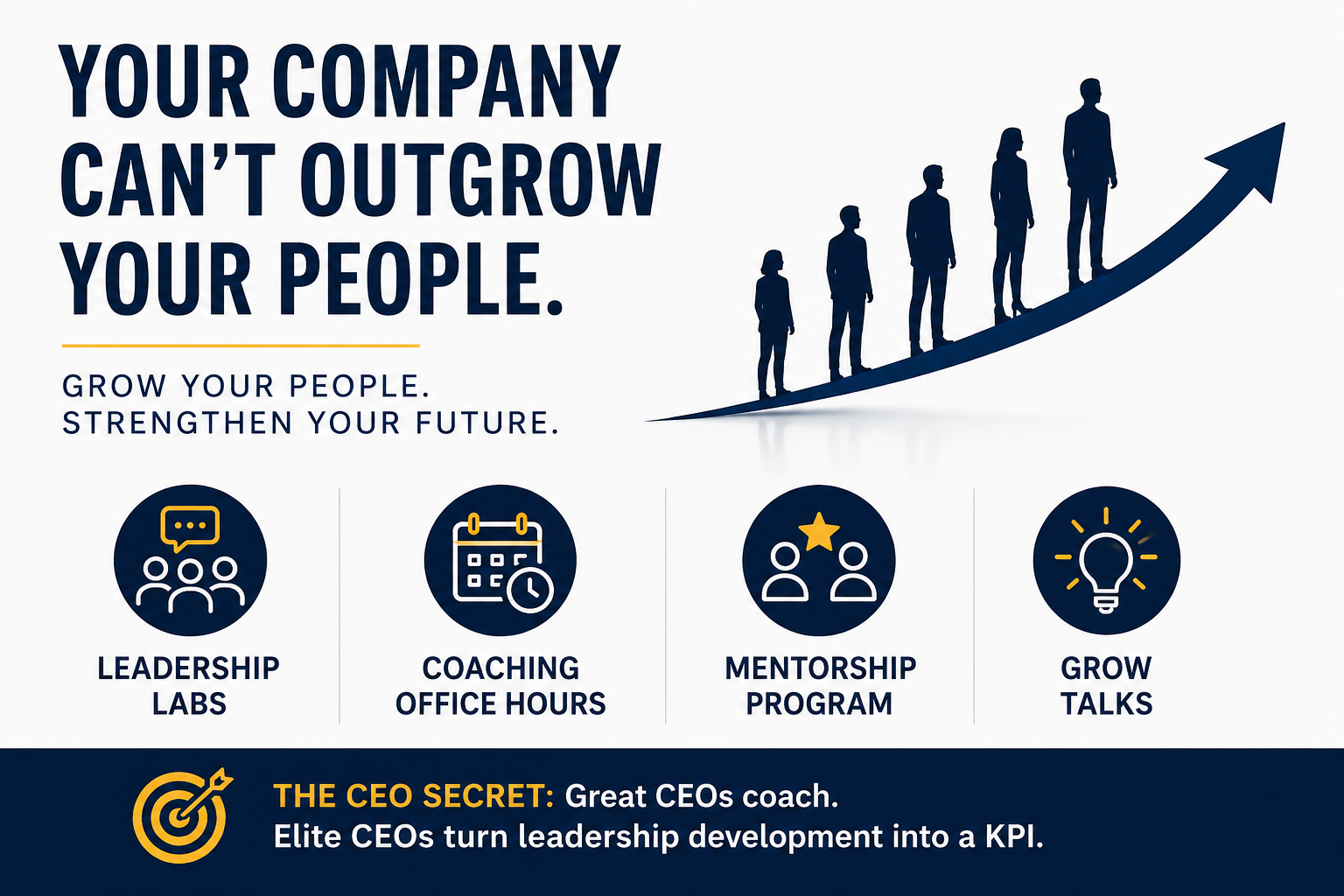
Grow your people faster than your company is growing.
Make that a core value.
Better yet, make it part of how you operate the company.
You don’t need a massive training department or a huge budget.
You need commitment and some simple habits.
Here are four ideas I have seen work. None of these cost much. All of them require you to show up.
1. Leadership Labs
Once a month or once a quarter, bring founders, leaders, and managers together to address real team challenges.
Make it a lunch-and-learn.
Take it off-site occasionally.
Do not make it another PowerPoint training session.
Bring in a real problem.
Discuss it.
Challenge assumptions.
Let people learn from each other.
You are developing leadership while solving problems that already exist inside the company.
2. Coaching Office Hours
Bring in a coach every other week or once a month for your senior leaders.
Give them an opportunity to discuss the problems they are actually facing.
Then expect those leaders to transfer what they learn to their own teams.
Think about professional sports.
There is a head coach. There are also coaches for specific positions and specialties.
Why do we expect business leaders to perform at an elite level without coaching?
3. Build a Mentorship Program
Pair individual contributors with senior leaders.
Let them learn from someone who has already been through some of the challenges they will face.
But don’t make mentorship about the senior person giving all the answers.
Challenge people.
Ask questions.
Give them exposure to situations outside their current responsibilities.
Help them see what the next level looks like.
You are not simply developing an employee.
You may be developing one of your future leaders.
4. Create Internal “Grow Talks”
Your own employees already possess enormous amounts of knowledge.
Use it.
Have engineers teach engineers.
Have salespeople share what they are learning from customers.
Let product leaders explain how they make tradeoffs.
Have someone teach the rest of the team something they learned from a mistake.
Customize the concept for your company.
The important part is to make learning a habit rather than an event.
Make Development Part of the Culture
Here is where CEOs often get this wrong.
They create a training program.
They announce it.
Everyone gets excited.
Three months later, it disappears.
That is not a learning culture.
A learning culture becomes part of how the company operates.
Coach your leaders.
Start early and small.
Create a “learn and teach” culture.
Reward people who grow others.
Use feedback as fuel.
Recognize people who teach their teammates.
Most important, create your company development playbook early.
Don’t wait until the organization is struggling.
The 90-Day Growth Engine Challenge
In What Every CEO Must Know, I included a simple 90-day challenge CEOs can implement without a big budget.
Start with three rituals.
First, hold a 30-minute Grow Talk once a month. Bring your leaders and experts together to solve one real business problem. Rotate who leads it. Make learning everyone’s responsibility, not just yours.
Second, launch a 30-minute mentorship program.
Third, track what happens.
Capture the lessons.
Record useful insights.
Recognize the people contributing them.
At the end of 90 days, look at what changed.
Then refine it.
Repeat it.
Now you are no longer running a training program.
You are building a leadership development muscle into the day-to-day operation of your company.
I’ve Seen What Happens When CEOs Wait
In the bonus section of Chapter 14, I share the story of the Opportunist, a first-time CEO I worked with.
He had overlooked training and coaching for his leadership team.
After several years, growth plateaued.
We retooled the leadership team. He brought in Vistage to help him and his leaders develop. We implemented scorecards with SMART goals. Each leader knew the other leaders’ scorecards.
The company broke through the plateau, returned to growth, and ultimately achieved a successful exit.
The lesson was not simply that the company needed different people.
It needed stronger leadership across the board.
There is a big difference.
Here Is the Reality
CEOs love to say:
“Our people are our greatest asset.”
Fine.
Prove it.
Secret #14 in my book is:
Great CEOs coach. But elite CEOs turn leadership development into a KPI.
Assign each senior leader responsibility and accountability for developing their team.
Make employee growth visible.
Make it measurable.
Celebrate it.
Imagine asking this question in your next executive meeting:
Who did you develop this month, and how did they grow?
That changes the conversation.
Now employee development isn’t an HR initiative.
It is a leadership responsibility.
And that may expose a blind spot in your company right now.
You may be investing heavily in growing revenue, customers, products, technology, and market share.
But are you investing just as deliberately in developing the people who have to deliver it all?
Grow your people faster than your company is growing.
Because the strongest CEOs don’t just build companies.
They create leaders.
Bill Miller is the author of What Every CEO Must Know, 37 Secrets to Lead with Confidence and Power, and The Rookie CEO, You Can’t Make This Stuff Up! He is the creator of the CEO Navigator System and advises founders, first-time CEOs, and growth-stage leaders on uncovering blind spots, making better decisions, and improving execution.
Thank you for stopping by the CEO Insights Blog. Please stop back regularly for new, original content.
Where are your blind spots hiding? Take my free CEO Navigator Assessment here.
Links to my books are also on my website.